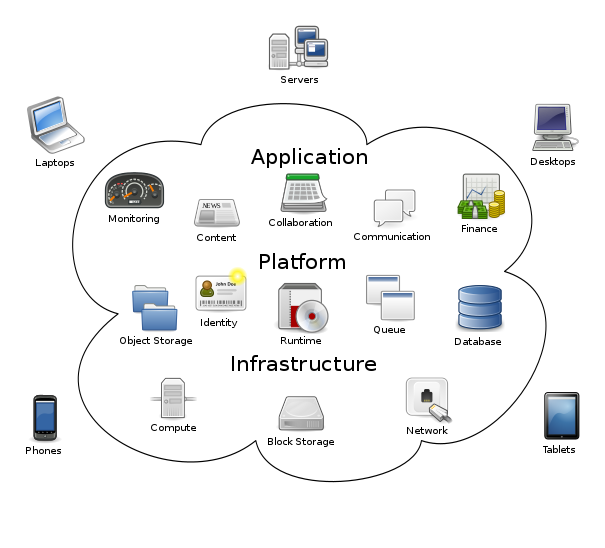
Keep It Simple and Straight.
There are various ways to articulate cloud computing and many definition differs.
I have tried to put the Cloud computing in a simpler way hope this helps:
Cloud computing is a general term for anything that involves delivering hosted services over the Internet. These services are broadly divided into three categories: Infrastructure-as-a-Service (IaaS), Platform-as-a-Service (PaaS) and Software-as-a-Service (SaaS). The name cloud computing was inspired by the cloud symbol that's often used to represent the Internet in flowcharts and diagrams.
A cloud service has three distinct characteristics that differentiate it from traditional hosting. It is sold on demand, typically by the minute or the hour; it is elastic -- a user can have as much or as little of a service as they want at any given time; and the service is fully managed by the provider (the consumer needs nothing but a personal computer and Internet access). Significant innovations in virtualization and distributed computing, as well as improved access to high-speed Internet and a weak economy, have accelerated interest in cloud computing.
What are you interested in learning more about?
a. Building a private cloud
b. Using the cloud for development and testing
c. Security and the cloud
d. Understanding cloud computing pricing
A cloud can be private or public. A public cloud sells services to anyone on the Internet. (Currently, Amazon Web Services is the largest public cloud provider.) A private cloud is a proprietary network or a data center that supplies hosted services to a limited number of people. When a service provider uses public cloud resources to create their private cloud, the result is called a virtual private cloud. Private or public, the goal of cloud computing is to provide easy, scalable access to computing resources and IT services.
Infrastructure-as-a-Service like Amazon Web Services provides virtual server instances with unique IP addresses and blocks of storage on demand. Customers use the provider's application program interface (API) to start, stop, access and configure their virtual servers and storage. In the enterprise, cloud computing allows a company to pay for only as much capacity as is needed, and bring more online as soon as required. Because this pay-for-what-you-use model resembles the way electricity, fuel and water are consumed, it's sometimes referred to as utility computing.
Platform-as-a-service in the cloud is defined as a set of software and product development tools hosted on the provider's infrastructure. Developers create applications on the provider's platform over the Internet. PaaS providers may use APIs, website portals or gateway software installed on the customer's computer. Force.com, (an outgrowth of Salesforce.com) and GoogleApps are examples of PaaS. Developers need to know that currently, there are not standards for interoperability or data portability in the cloud. Some providers will not allow software created by their customers to be moved off the provider's platform.
In the software-as-a-service cloud model, the vendor supplies the hardware infrastructure, the software product and interacts with the user through a front-end portal. SaaS is a very broad market. Services can be anything from Web-based email to inventory control and database processing. Because the service provider hosts both the application and the data, the end user is free to use the service from anywhere.
There are various ways to articulate cloud computing and many definition differs.
I have tried to put the Cloud computing in a simpler way hope this helps:
Cloud computing is a general term for anything that involves delivering hosted services over the Internet. These services are broadly divided into three categories: Infrastructure-as-a-Service (IaaS), Platform-as-a-Service (PaaS) and Software-as-a-Service (SaaS). The name cloud computing was inspired by the cloud symbol that's often used to represent the Internet in flowcharts and diagrams.
A cloud service has three distinct characteristics that differentiate it from traditional hosting. It is sold on demand, typically by the minute or the hour; it is elastic -- a user can have as much or as little of a service as they want at any given time; and the service is fully managed by the provider (the consumer needs nothing but a personal computer and Internet access). Significant innovations in virtualization and distributed computing, as well as improved access to high-speed Internet and a weak economy, have accelerated interest in cloud computing.
What are you interested in learning more about?
a. Building a private cloud
b. Using the cloud for development and testing
c. Security and the cloud
d. Understanding cloud computing pricing
A cloud can be private or public. A public cloud sells services to anyone on the Internet. (Currently, Amazon Web Services is the largest public cloud provider.) A private cloud is a proprietary network or a data center that supplies hosted services to a limited number of people. When a service provider uses public cloud resources to create their private cloud, the result is called a virtual private cloud. Private or public, the goal of cloud computing is to provide easy, scalable access to computing resources and IT services.
Infrastructure-as-a-Service like Amazon Web Services provides virtual server instances with unique IP addresses and blocks of storage on demand. Customers use the provider's application program interface (API) to start, stop, access and configure their virtual servers and storage. In the enterprise, cloud computing allows a company to pay for only as much capacity as is needed, and bring more online as soon as required. Because this pay-for-what-you-use model resembles the way electricity, fuel and water are consumed, it's sometimes referred to as utility computing.
Platform-as-a-service in the cloud is defined as a set of software and product development tools hosted on the provider's infrastructure. Developers create applications on the provider's platform over the Internet. PaaS providers may use APIs, website portals or gateway software installed on the customer's computer. Force.com, (an outgrowth of Salesforce.com) and GoogleApps are examples of PaaS. Developers need to know that currently, there are not standards for interoperability or data portability in the cloud. Some providers will not allow software created by their customers to be moved off the provider's platform.
In the software-as-a-service cloud model, the vendor supplies the hardware infrastructure, the software product and interacts with the user through a front-end portal. SaaS is a very broad market. Services can be anything from Web-based email to inventory control and database processing. Because the service provider hosts both the application and the data, the end user is free to use the service from anywhere.
Now make it easier to grasp
Cloud computing is Internet-based computing, whereby shared resources, software and information are provided to computers and other devices on-demand, like the electricity grid.
It is a paradigm shift following the shift from mainframe to client–server that preceded it in the early 1980s. Details are abstracted from the users who no longer have need of, expertise in, or control over the technology infrastructure "in the cloud" that supports them.Cloud computing describes a new supplement, consumption and delivery model for IT services based on the Internet, and it typically involves the provision of dynamically scalable and often virtualized resources as a service over the Internet.It is a byproduct and consequence of the ease-of-access to remote computing sites provided by the Internet.
The term "cloud" is used as a metaphor for the Internet, based on the cloud drawing used in the past to represent the telephone network, and later to depict the Internet in computer network diagrams as an abstraction of the underlying infrastructure it represents.Typical cloud computing providers deliver common business applications online which are accessed from another web service or software like a web browser, while the software and data are stored on servers.
Most cloud computing infrastructure consists of reliable services delivered through data centers and built on servers. Clouds often appear as single points of access for all consumers' computing needs. Commercial offerings are generally expected to meet quality of service (QoS) requirements of customers and typically offer SLAs.

Architecture
Cloud computing sample architecture
Cloud architecture,the systems architecture of the software systems involved in the delivery of cloud computing, typically involves multiple cloud components communicating with each other over application programming interfaces, usually web services.Complexity is controlled and the resulting systems are more manageable than their monolithic counterparts.
History
The underlying concept of cloud computing dates back to 1960, when John McCarthy opined that "computation may someday be organized as a public utility"; indeed it shares characteristics with service bureaus that date back to the 1960s. The actual term "cloud" borrows from telephony in that telecommunications companies, who until the 1990s primarily offered dedicated point-to-point data circuits, began offering Virtual Private Network (VPN) services with comparable quality of service but at a much lower cost. By switching traffic to balance utilization as they saw fit they were able to utilise their overall network bandwidth more effectively. The cloud symbol was used to denote the demarcation point between that which was the responsibility of the provider from that of the user. Cloud computing extends this boundary to cover servers as well as the network infrastructure.
Amazon played a key role in the development of cloud computing by modernizing their data centers after the dot-com bubble, which, like most computer networks, were using as little as 10% of their capacity at any one time just to leave room for occasional spikes. Having found that the new cloud architecture resulted in significant internal efficiency improvements whereby small, fast-moving "two-pizza teams" could add new features faster and easier, Amazon started providing access to their systems through Amazon Web Services on a utility computing basis in 2006.
In 2007, Google, IBM, and a number of universities embarked on a large scale cloud computing research project.[23] By mid-2008, Gartner saw an opportunity for cloud computing "to shape the relationship among consumers of IT services, those who use IT services and those who sell them",[24] and observed that "[o]rganisations are switching from company-owned hardware and software assets to per-use service-based models" so that the "projected shift to cloud computing ... will result in dramatic growth in IT products in some areas and significant reductions in other areas."[25]
Key features:
Agility improves with users' ability to rapidly and inexpensively re-provision technological infrastructure resources. Cost is claimed to be greatly reduced and capital expenditure is converted to operational expenditure.This ostensibly lowers barriers to entry, as infrastructure is typically provided by a third-party and does not need to be purchased for one-time or infrequent intensive computing tasks. Pricing on a utility computing basis is fine-grained with usage-based options and fewer IT skills are required for implementation (in-house).
Device and location independence enable users to access systems using a web browser regardless of their location or what device they are using (e.g., PC, mobile). As infrastructure is off-site (typically provided by a third-party) and accessed via the Internet, users can connect from anywhere.
Multi-tenancy enables sharing of resources and costs across a large pool of users thus allowing for:
Centralization of infrastructure in locations with lower costs (such as real estate, electricity, etc.). Peak-load capacity increases (users need not engineer for highest possible load-levels) Utilization and efficiency improvements for systems that are often only 10–20% utilized.
Reliability improves through the use of multiple redundant sites, which makes cloud computing suitable for business continuity and disaster recovery. Nonetheless, many major cloud computing services have suffered outages, and IT and business managers can at times do little when they are affected.
Scalability via dynamic ("on-demand") provisioning of resources on a fine-grained, self-service basis near real-time, without users having to engineer for peak loads. Performance is monitored, and consistent and loosely coupled architectures are constructed using web services as the system interface. One of the most important new methods for overcoming performance bottlenecks for a large class of applications is data parallel programming on a distributed data grid.
Security could improve due to centralization of data, increased security-focused resources, etc., but concerns can persist about loss of control over certain sensitive data, and the lack of security for stored kernels Security is often as good as or better than under traditional systems, in part because providers are able to devote resources to solving security issues that many customers cannot afford.Providers typically log accesses, but accessing the audit logs themselves can be difficult or impossible. Furthermore, the complexity of security is greatly increased when data is distributed over a wider area and / or number of devices.
Maintenance cloud computing applications are easier to maintain, since they don't have to be installed on each user's computer. They are easier to support and to improve since the changes reach the clients instantly.
Metering cloud computing resources usage should be measurable and should be metered per client and application on daily, weekly, monthly, and annual basis. This will enable clients on choosing the vendor cloud on cost and reliability (QoS).
Layers
Client
A cloud client consists of computer hardware and/or computer software that relies on cloud computing for application delivery, or that is specifically designed for delivery of cloud services and that, in either case, is essentially useless without it. Examples include some computers, phones and other devices, operating systems and browsers.
Application
Cloud application services or "Software as a Service (SaaS)" deliver software as a service over the Internet, eliminating the need to install and run the application on the customer's own computers and simplifying maintenance and support. Key characteristics include:
Network-based access to, and management of, commercially available (i.e., not custom) software
Activities that are managed from central locations rather than at each customer's site, enabling customers to access applications remotely via the Web Application delivery that typically is closer to a one-to-many model (single instance, multi-tenant architecture) than to a one-to-one model, including architecture, pricing, partnering, and management characteristics
Centralized feature updating, which obviates the need for downloadable patches and upgrades.
Platform
Cloud platform services or "Platform as a Service (PaaS)" deliver a computing platform and/or solution stack as a service, often consuming cloud infrastructure and sustaining cloud applications.It facilitates deployment of applications without the cost and complexity of buying and managing the underlying hardware and software layers.
Infrastructure
Cloud infrastructure services or "Infrastructure as a Service (IaaS)" delivers computer infrastructure, typically a platform virtualization environment as a service. Rather than purchasing servers, software, data center space or network equipment, clients instead buy those resources as a fully outsourced service. The service is typically billed on a utility computing basis and amount of resources consumed (and therefore the cost) will typically reflect the level of activity. It is an evolution of virtual private server offerings.
Server
The servers layer consists of computer hardware and/or computer software products that are specifically designed for the delivery of cloud services, including multi-core processors, cloud-specific operating systems and combined offerings.
Deployment models
Cloud computing types
Public cloud
Public cloud or external cloud describes cloud computing in the traditional mainstream sense, whereby resources are dynamically provisioned on a fine-grained, self-service basis over the Internet, via web applications/web services, from an off-site third-party provider who shares resources and bills on a fine-grained utility computing basis.
Community cloud
A community cloud may be established where several organizations have similar requirements and seek to share infrastructure so as to realize some of the benefits of cloud computing. With the costs spread over fewer users than a public cloud (but more than a single tenant) this option is more expensive but may offer a higher level of privacy, security and/or policy compliance. Examples of community cloud include Google's "Gov Cloud".
Hybrid cloud
A hybrid cloud environment consisting of multiple internal and/or external providers"will be typical for most enterprises". By integrating multiple cloud services users may be able to ease the transition to public cloud services while avoiding issues such as PCI compliance.
Another perspective on deploying a web application in the cloud is using Hybrid Web Hosting, where the hosting infrastructure is a mix between Cloud Hosting for the web server, and Managed dedicated server for the database server.
Private cloud
Private cloud and internal cloud are neologisms that some vendors have recently used to describe offerings that emulate cloud computing on private networks. These (typically virtualisation automation) products claim to "deliver some benefits of cloud computing without the pitfalls", capitalising on data security, corporate governance, and reliability concerns. They have been criticized on the basis that users "still have to buy, build, and manage them" and as such do not benefit from lower up-front capital costs and less hands-on management, essentially "[lacking] the economic model that makes cloud computing such an intriguing concept".